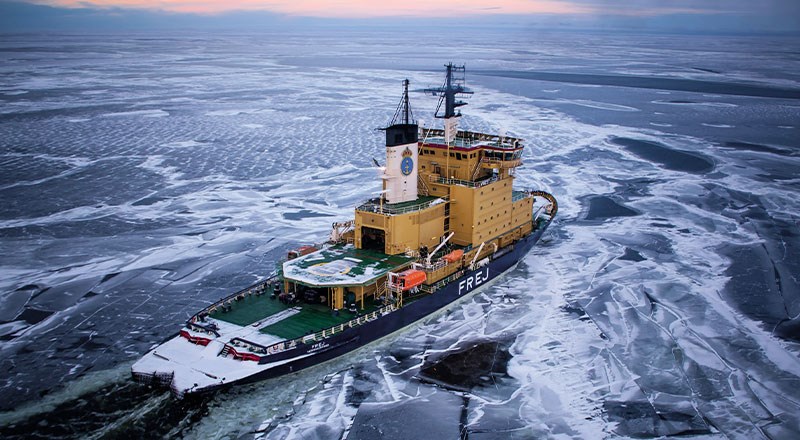
Swedish Maritime Administration proposes state funding for icebreaking
News 2026-10-23

The Swedish Government should assume full financial responsibility for state-funded icebreaking. This is the proposal put forward by the Swedish Maritime Administration as it submits its three-year plan and budget request to the Government.
— Nine out of ten goods exported from and imported into Sweden are transported by sea. Swedish industry is heavily dependent on shipping that operates all year round, regardless of the weather. Icebreaking should be treated in the same way as winter road maintenance on land, says Erik Eklund, Director-General of the Swedish Maritime Administration.
Icebreaking is not funded through taxation but is paid for collectively by the shipping industry through fairway dues. In an average year, icebreaking costs just over SEK 400 million, but during a particularly severe winter, costs can be hundreds of millions of kronor higher.
Despite substantial cost-cutting measures and additional government funding for 2026, the financial outlook remains bleak, with funds projected to run out by the end of 2028. One reason is that the number of vessels arriving at and departing from Swedish ports has declined by two per cent annually since 2008.
— Swedish ports need to remain open and safe throughout the year, across the entire country. Sweden is entirely dependent on its sea routes, not least from a preparedness perspective. To secure the Swedish Maritime Administration’s operations in the long term, we therefore propose that the state assume full financial responsibility for icebreaking, says Erik Eklund.
State funding for icebreaking would free up revenue from fairway dues, enabling the Swedish Maritime Administration to address long-standing maintenance backlogs in fairways, ageing vessels and measures needed to achieve climate targets.
The Swedish Maritime Administration also proposes increased government funding to cover administrative costs, including coordination with other authorities. There is considerable potential for its resources and expertise to be used in areas that do not directly benefit commercial shipping.
— This could include providing other authorities with marine geographical information, participating in investigations into maritime matters, providing helicopter assistance during operations or similar activities, says Erik Eklund.
Read our full three-year plan and budget request for 2027–2029 here (in Swedish)
Facts about icebreaking
This year's ice coverage is the most extensive in 15 years and among the six most severe in the past 40 years. Read more about ice coverage: Map – Baltice.org
Icebreaking is funded through fairway dues paid to the Swedish Maritime Administration. These dues are charged to all vessels arriving at or departing from Swedish ports. One third of the revenue from fairway dues goes towards icebreaking, although only one per cent of those paying the dues use the service.
The Swedish Maritime Administration ensures that all Swedish ports can remain open throughout the year by breaking ice at sea and assisting, directing, guiding and towing vessels that have difficulty navigating through ice. The Swedish Maritime Administration has six icebreakers: Ale, Atle, Frej, Ymer, Oden and Idun. Several of the icebreakers are 50 years old.
The Swedish Maritime Administration's work vessels Baltica and Scandica also have icebreaking capabilities and are part of the icebreaking operations as auxiliary icebreakers.